

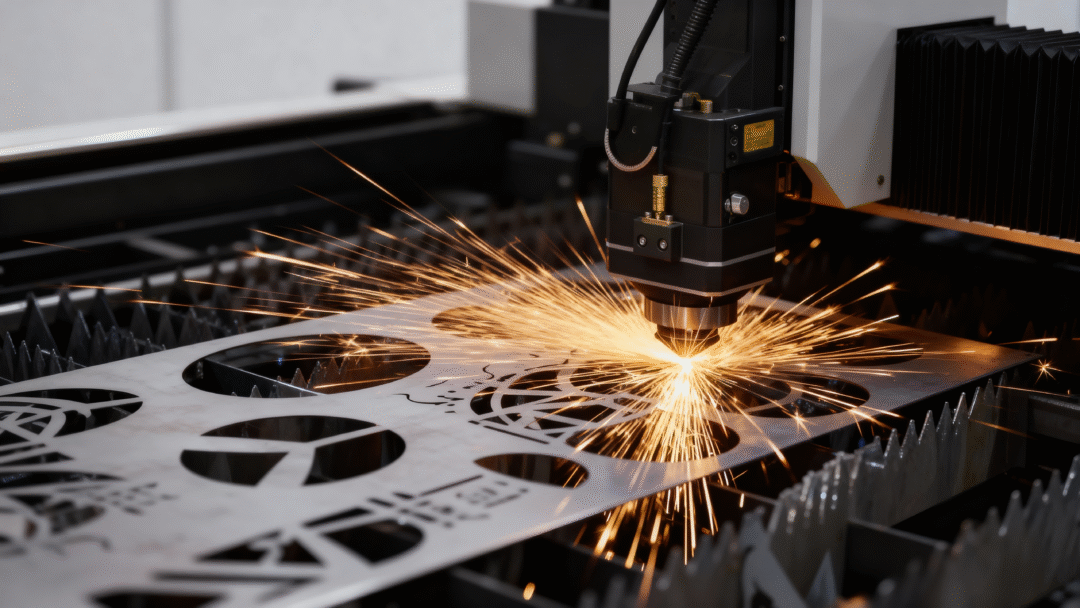
Metal laser cutting has revolutionised how metal components are made — delivering high-speed precision, minimal waste, and exceptional design flexibility. In Singapore, this advanced technology has become the backbone of modern metal fabrication, used in industries ranging from construction to marine engineering.
In fact, many local metal fabrication companies engage us to carry out their laser-cutting projects because a laser cutting machine is too expensive — we bought ours for $500,000 in 2007. This not only reflects the trust the industry places in us, but also our position as one of Singapore’s few all-in-one metal works specialists capable of delivering everything — from concept to completion.
In this guide, we’ll explain what metal laser cutting is, how it works, and how it differs from traditional fabrication processes — plus what factors affect cost and quality.
What Is Metal Laser Cutting?
Metal laser cutting is a manufacturing process that uses a CO₂ laser beam to cut metal sheets into precise shapes and designs. The process is computer-controlled and non-contact, meaning there’s no physical tool pressure on the material.
A laser beam is directed onto the surface of the metal, melting or vaporising the targeted area. This allows for extremely accurate cuts, even on thin or delicate sheets that could otherwise deform under mechanical cutting pressure.
How Does Metal Laser Cutting Work?
At Feng Sheng Metal Works, the process begins by programming a digital design using CAD software. The design file is uploaded to the laser cutting system, which automates the operation and controls the cutting path with high-speed motion systems.
Here’s the typical workflow:
-
Design Creation – Engineers create a digital design (CAD) with precise dimensions.
-
Programming – The CAD file is converted into cutting instructions.
-
Laser Cutting – A focused CO₂ laser beam cuts through the metal along the programmed path.
-
Finishing – Minimal post-processing is needed since laser cuts are clean and smooth.
This system is ideal for:
-
Complex patterns or detailed engravings
-
Small holes or narrow profiles
-
Thin metals that distort under pressure
-
Projects requiring repeatable precision
What Materials Can Be Laser Cut?
Metal laser cutting works with a wide range of materials, including:
-
Mild Steel
-
Stainless Steel
-
Aluminium
-
Galvanised Steel
Each material reacts differently to heat and cutting speed, which is why calibration and laser power control are key to achieving a perfect finish.
Advantages of Metal Laser Cutting
-
High Precision – Achieve tolerance levels as tight as ±0.1mm.
-
Speed and Efficiency – Automated systems enable high-volume output with minimal error.
-
Reduced Waste – Optimised cutting paths reduce material wastage.
-
Clean Finishes – No need for extensive polishing or grinding after cutting.
-
Versatility – Can be used for prototyping, signage, decorative panels, railings, and industrial parts.
How Much Does Metal Laser Cutting Cost in Singapore?
There’s no fixed cost because laser cutting is usually done to custom specifications. The final cost depends on several factors:
-
Material type and thickness
-
Cutting time and complexity
-
CAD programming and setup
-
Labour involved in finishing and installation
What’s the Difference Between Metal Laser Cutting and Metal Fabrication?
While metal laser cutting is one of the processes used within metal fabrication, the two are not the same.
| Aspect | Metal Laser Cutting | Metal Fabrication |
|---|---|---|
| Definition | A precise cutting method using a focused laser beam to shape metal sheets. | The complete process of creating metal structures or parts — includes cutting, bending, welding, polishing, and assembly. |
| Focus | Accuracy and precision in cutting designs. | Full project execution — from raw material to finished product. |
| Tools Used | CO₂ laser, CAD software, automated systems. | Laser cutter, press brake, welder, roller, milling and polishing machines. |
| Output | Cut metal pieces or components. | Finished structures, assemblies, or custom parts. |
In short, laser cutting is one stage in the broader metal fabrication process. At Feng Sheng, we integrate laser cutting with bending, rolling, welding, and finishing to deliver complete metal solutions — from design to installation.
Applications of Metal Laser Cutting in Singapore
Laser cutting is widely used across industries that demand both precision and efficiency:
-
Architecture and Interior Design – Custom panels, signage, and decorative facades.
-
Construction and Engineering – Brackets, railings, and components for structural use.
-
Marine and Offshore – Corrosion-resistant stainless steel components.
-
Manufacturing – Machine parts, enclosures, and prototypes.
Its versatility makes it one of the most cost-effective solutions for custom and industrial-scale projects alike.
Why Choose Feng Sheng Metal Works
Established as a family-run business with decades of experience, Feng Sheng combines craftsmanship and modern laser cutting technology to produce high-quality results tailored to each project.
Our two in-house laser cutting machines, upgraded since 2007, allow us to deliver:
-
High-speed precision cutting
-
Custom programming for intricate designs
-
Consistent quality control
-
Reduced production time
Every project is custom-fabricated — not mass-produced — ensuring clients receive durable, well-finished products designed to meet exact specifications.